


Cyborg ERP - On-Screen Marking System
Revolutionizing the Way Institutions Evaluate Exams
Cyborg OSM (On-Screen Marking System) is an advanced digital evaluation solution developed as part of the Cyborg ERP suite. It is built to transform how schools, colleges, and universities manage the answer sheet evaluation process.
This system replaces manual, paper-based checking with a secure, paperless, and cloud-based evaluation platform. Examiners can now check and grade answer scripts digitally — from anywhere, anytime — with full data security, real-time monitoring, and transparent evaluation workflows.
Key Features of Cyborg Digital Evaluation (Cyborg-OSM)
Everything You Need for Fast, Accurate, and Transparent Assessments
On-Screen Evaluation of Answer Scripts
Scanned answer sheets are uploaded to a secure portal, where authorized examiners can evaluate digitally — reducing paperwork and improving turnaround time.
Supports CBCS, Grading, and Mark-Based Evaluation
Compatible with CBCS, grade-based, and traditional mark-based systems. The platform auto-calculates totals based on defined rules.
Auto Tabulation and Real-Time Result Compilation
Section-wise scoring, examiner remarks, and total marks are calculated instantly with zero manual errors.
Remote Access for Examiners
Faculty can securely log in from any location to evaluate scripts, with activity tracking and OTP-based access for added security.
Highly Secure & Confidential
Data encryption, watermarking, and strict role-based access controls ensure your evaluations stay confidential and tamper-proof.
Live Dashboard for Exam Controllers
Track the progress of each evaluator, monitor pending answer scripts, and manage all activity from a centralized control panel.
Seamless Integration with Result Publishing
Evaluated marks feed directly into Cyborg ERP’s result processing system, allowing one-click result approvals and student access.
Complete Audit Trail & Accountability
All evaluation actions are time-stamped and logged — offering full traceability for internal audits, grievance handling, and compliance.
How the Digital Evaluation System Works
Onscreen Marking, Fast Result Processing & Secure Student Access
📑 Step-by-Step Evaluation Process
1. Barcoded Answer Sheets
Each sheet is tagged with a unique barcode — auto-sorted and stored in folders after scanning.
2. Sheet Preparation
Post-exam, answer sheets are separated using a cutting machine and prepared for digital upload.
3. Scanning & Upload
High-speed scanners convert sheets into encrypted images stored securely on a cloud server.
4. Define Questions
Admins configure question types including OR, AND, compulsory, and randomized patterns.
5. Onscreen Evaluation
Evaluators can check copies from any location using secure two-step verification.
6. Student Access
Students receive digital copies of marked answer sheets to review evaluation fairness.
7. Easy Rechecking
Re-evaluation is simplified — no physical handling required. Requests are processed quickly.
8. Fast Result Generation
Final marks are auto-tabulated and exported in formats like Excel or integrated into ERP.
Manual vs Digital Evaluation
| Manual Process | Digital Evaluation |
|---|---|
| Physical handling at each stage | One-time scanning eliminates physical steps |
| Centralized physical checking by moderators | Remote access for evaluators from anywhere |
| 10–15 mins per sheet | 5 mins or less per sheet digitally |
| Delayed, error-prone result tabulation | Instant, accurate result processing |
| Manual rechecking and photocopy handling | Online re-evaluation & student copy access |
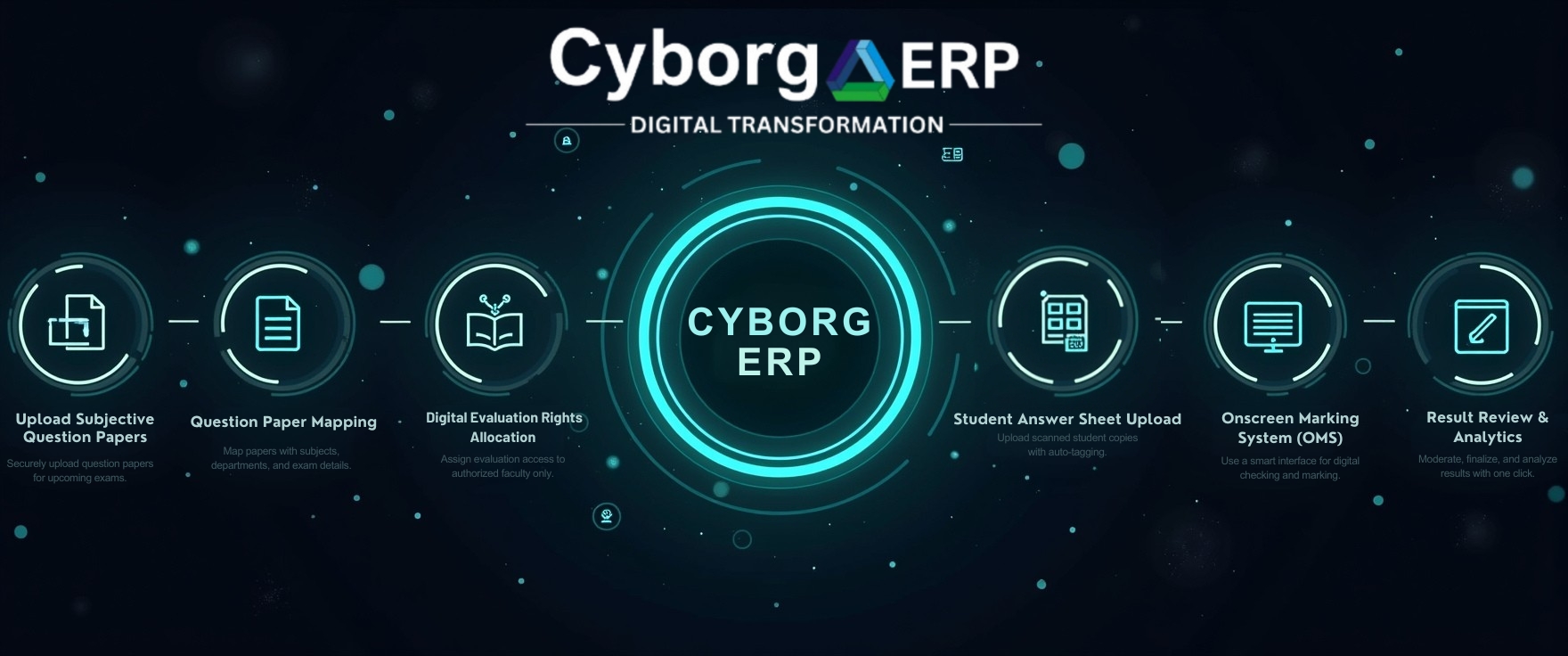
Why Choose Cyborg-OSM for Digital Evaluation?
Benefits of Onscreen Marking System
- High Speed and Efficiency: Accelerates evaluation time for MCQs and objective sections, enabling faster result declarations.
- Better Feedback and Analysis: Offers detailed performance analytics and personalized feedback, helping students identify areas of improvement.
- Accuracy and Fairness: Reduces human error with automated scoring logic, ensuring unbiased and accurate evaluations.
- High Scalability: Easily accommodates large student volumes, making it ideal for universities and competitive exams.
- Convenience: Enables evaluators to assess answer sheets remotely and flexibly, improving overall workflow.
- High Security: Features like OTP login and encryption ensure exam integrity and protection of student data.
What Kinds of Institutions Opt for Digital Evaluation Systems?
Digital evaluation solutions are widely adopted by educational boards, schools, colleges, and coaching centers to streamline assessments. They are also used by corporate organizations for training certification and compliance testing due to their scalability and security features.
Implementation of Digital Evaluation System
Deployment involves setting up barcode-enabled answer sheets, scanning solutions, and configuring question paper patterns. Post-scanning, the sheets are uploaded and made accessible to evaluators who can log in securely to mark and comment on each response. Final marks are auto-compiled and exported to result dashboards.
The Ultimate Guide to Digital Evaluation & Onscreen Marking Systems for Institutions
Bonus: How This Helps in Accreditation & Rankings
Digital evaluation not only improves efficiency but also aligns with key accreditation requirements and boosts institutional rankings by ensuring transparency and timely results.
| Parameter | Benefit of Digital Evaluation |
|---|---|
| NAAC SSR: Teaching–Learning | ICT-based assessments, automation |
| UGC/AICTE Guidelines | Transparency in academic evaluations |
| NEP 2020 Focus Areas | Use of digital tools, decentralization |
| NIRF Rankings | Operational efficiency and result timelines |
❌ Myths vs ✅ Facts About Digital Evaluation
Many misconceptions surround digital evaluation, but the reality is that it simplifies assessments, ensures transparency, and reduces costs for institutions of every size.
| ❌ Myth | ✅ Reality |
|---|---|
| It’s only for tech universities | Even arts & nursing colleges use it successfully |
| Faculty won’t adopt it | Over 90% adapt within 1–2 sessions |
| It’s expensive | Saves ₹5–10 lakhs annually |
| Data can be tampered | Role-based access + encryption prevent this |
| Training takes months | Cyborg’s UI is intuitive, with video training available |
| It replaces human checking | It only digitizes and enhances it |
Post-Evaluation Scrutiny
Students can see their evaluated answer sheets along with the comments from the examiners after the declaration of results. Students are also given the ability to recheck by depositing the prescribed fee, which will be automated through the Onscreen Marking system.
📚 Frequently Asked Questions (FAQs)
A Digital Evaluation System allows universities to scan and evaluate handwritten answer sheets digitally. Examiners can check them onscreen using annotation tools, ensuring speed and accuracy.
It scans answer sheets, uploads them securely to the cloud, and allows authorized examiners to mark them from anywhere with auto-totaling, moderation, and instant result sync with ERP.
Yes. It uses encryption, OTP verification, audit trails, and role-based access, fully compliant with Indian data privacy and academic governance policies.
All exams including objective, subjective, theory, practical, semester-based, annual, and CBCS are supported with features like question-wise mapping and OR/AND logic.
Yes, Cyborg OSM integrates with existing ERP, SIS, or LMS platforms using secure APIs and direct database syncs for seamless result management.
Yes. Students can securely view marked copies after result publication, promoting transparency and reducing re-evaluation requests.
The system can be rolled out within 30 days, including setup, faculty training, and data migration, depending on the institution size and infrastructure.
Yes. It aligns with NAAC SSR, NEP 2020, and UGC/AICTE ICT governance norms, helping institutions improve transparency and accreditation scores.
